




-
Homo Deus: A History of Tomorrow
Yuval Noah Harari, author of the critically-acclaimed New York Times bestseller and international phenomenon Sapiens, returns with an equally original, compelling, and provocative book, turning his focus toward humanity’s future, and our quest to upgrade humans into gods.
Over the past century humankind has managed to do the impossible and rein in famine, plague, and war. This may seem hard to accept, but, as Harari explains in his trademark style—thorough, yet riveting—famine, plague and war have been transformed from incomprehensible and uncontrollable forces of nature into manageable challenges. For the first time ever, more people die from eating too much than from eating too little; more people die from old age than from infectious diseases; and more people commit suicide than are killed by soldiers, terrorists and criminals put together. The average American is a thousand times more likely to die from binging at McDonalds than from being blown up by Al Qaeda.
What then will replace famine, plague, and war at the top of the human agenda? As the self-made gods of planet earth, what destinies will we set ourselves, and which quests will we undertake? Homo Deus explores the projects, dreams and nightmares that will shape the twenty-first century—from overcoming death to creating artificial life. It asks the fundamental questions: Where do we go from here? And how will we protect this fragile world from our own destructive powers? This is the next stage of evolution. This is Homo Deus.
With the same insight and clarity that made Sapiens an international hit and a New York Times bestseller, Harari maps out our future.
₨ 1,120.00Homo Deus: A History of Tomorrow
₨ 1,120.00 -
Hippie
In Hippie, his most autobiographical novel to date, Paulo Coelho takes us back in time to re-live the dream of a generation that longed for peace and dared to challenge the established social order – authoritarian politics, conservative modes of behavior, excessive consumerism, and an unbalanced concentration of wealth and power.
Following the “three days of peace and music” at Woodstock, the 1969 gathering in Bethel, NY that would change the world forever, hippie paradises began to emerge all around the world. In the Dam Square in Amsterdam, long-haired young people wearing vibrant clothes and burning incense could be found meditating, playing music and discussing sexual liberation, the expansion of consciousness and the search for an inner truth. They were a generation refusing to live the robotic and unquestioning life that their parents had known.
At this time, Paulo is a young, skinny Brazilian with a goatee and long, flowing hair who wants to become a writer. He sets off on a journey in search of freedom and a deeper meaning for his life: first, with a girlfriend, on the famous “Death Train to Bolivia,” then on to Peru and later hitchhiking through Chile and Argentina.
His travels take him further, to the famous square in Amsterdam, where Paulo meets Karla, a Dutch woman also in her 20s. She convinces Paulo to join her on a trip to Nepal, aboard the Magic Bus that travels across Europe and Central Asia to Kathmandu. They embark on a journey in the company of fascinating fellow travelers, each of whom has a story to tell, and each of whom will undergo a transformation, changing their priorities and values, along the way. As they travel together, Paulo and Karla explore their own relationship, an awakening on every level that brings each of them to a choice and a decision that sets the course for their lives thereafter.
₨ 640.00Hippie
₨ 640.00 -
Himalayan Lust
Every year,a group of Isha (Foundation) meditators sets out on a tour of the HImalayas.Accompanying them on this journey is Sadhguru Jaggi Vasudev – a spiritual master considered by many to be one of the foremost living sages on the planet. This is a book for those who stayed behind.It is a chance to make piligrimage on the page,travelling through the unpredictable but fascinating terrain of the Master’s words.Amalgamating discourses and conversations from several yatras,it is a blend of the specific and the timeless. This book is not just about the Himalayas.And yet,the book would never have happened without the Himalayas.The mountains play a vital role in the text,alternatively as context and catalyst,mood and metaphor.
₨ 480.00Himalayan Lust
₨ 480.00 -
Hero (The Secret)
From Rhonda Byrne, creator of the international bestselling movie and book, The Secret, comes Hero, her latest world-changing project and the most important to date.
FROM ZERO TO HERO… YOUR SECRET MAP TO A RICH LIFE
What is your true calling and why aren’t you already living it?
Imagine if there was a map that showed you step by step how to get from where you are now to your true calling and the life you were born to live—the most brilliant, rich, fulfilling, and dazzling life you could ever dream of. You are holding in your hands such a map. Hero is the map for your life.
By following the journeys of twelve of the most successful people on the planet today, you’ll learn how to use your inner powers to overcome obstacles and to make impossible dreams come true. You’ll be inspired to find your own calling and start taking the steps toward making the life of your dreams an everyday reality.
Be the hero you are meant to be.
₨ 1,280.00Hero (The Secret)
₨ 1,280.00 -

Good Vibes, Good Life: How Self-Love Is the Key to Unlocking Your Greatness
How can you learn to truly love yourself? How can you transform negative emotions into positive ones? Is it possible to find lasting happiness?
In this book, Instagram guru Vex King answers all of these questions and more. Vex overcame adversity to become a source of hope for thousands of young people, and now draws from his personal experience and his intuitive wisdom to inspire you to:
* practice self-care, overcome toxic energy and prioritize your wellbeing
* cultivate positive lifestyle habits, including mindfulness and meditation
* change your beliefs to invite great opportunities into your life
* manifest your goals using tried-and-tested techniques
* overcome fear and flow with the Universe
* find your higher purpose and become a shining light for othersWith this book, Vex will show you that when you change the way you think, feel, speak and act, you begin to change the world.
₨ 800.00 -
Don’t Polish Your Ignorance …It May Shine
The persistent questions of seekers fill this book. It’s all here the pain, the confusion, the raging gut level thirst, all that it means to be human and alive and wanting. And through it all are the clear, strong, unwavering tones of a master who reminds us that the only thing that lies between the human and the divine, the finite and the boundless, the seeking and the finding, is choice.
What does that choice entail? Not the acquisition of any path breaking wisdom, but a determined refusal to strengthen one’s ignorance, to reinforce one’s deceptions, to gold plate ones limitations.
The danger, Sadhguru tells us, does not lie in being in the dark that can be dispelled for anyone who genuinely desires it but in settling for an easy brilliance, a spurious radiance. The danger does not lie in seeking urgently, but in arriving chealy.
Don’t polish your ignorance, he warns aphoristically, unforgettably, recurrently in the course of this book. It may shine.
₨ 480.00 -
Shiva Sutras Divine techniques for Enchancing Effectiveness
Ability is an important tool in life. Ability without commitment and awareness is like a vehicle without the engine. The Shiva Sutra enhances ones awareness in a way one sees an opportunity in a difficulty and not a difficulty in an opportunity. There is an outside reality and an inside reality of ones mind. There is also another dimension called spiritual reality. To harmonize all of them is a great awakening. Ordinary being loves ones own psycho dramas of justification, proving ones point of view, blaming, being helpless and this leads one to a state of inner poverty. To free oneself from these lower states of poverty and see them as errors in ones thinking is part of being effective and experiencing inner prosperity.
The profound teaching of Lord Shiva introduces us to A Bigger Container where one learns to be charitable to ones own self. This practice of making A Bigger Container is essentially spiritual. Dive deep into these mystic teachings. Swami Sukhabodhananda
₨ 560.00 -
Blink: The Power of Thinking Without Thinking
Blink: The Power of Thinking without thinking is Malcolm Gladwell’s second book. It presents in popular science format research from psychology and behavioral economics on the adaptive unconscious: mental processes that work rapidly and automatically from relatively little information. It considers both the strengths of the adaptive unconscious, for example in expert judgment, and its pitfalls, such as stereotypes.
“The author describes the main subject of his book as “”thin-slicing””: our ability to use limited information from a very narrow period of experience to conclude. This idea suggests that spontaneous decisions are often as good as—or even better than—carefully planned and considered ones. To reinforce his ideas, Gladwell draws from a wide range of examples from science and medicine (including malpractice suits), sales and advertising, gambling, speed dating (and predicting divorce), tennis, military war games, and the movies and popular music. Gladwell also uses many examples of regular people’s experiences with “”thin-slicing,”” including our instinctive ability to mind-read, which is how we can get to know a person’s emotions just by looking at his or her face.Gladwell explains how an expert’s ability to “”thin slice”” can be corrupted by their likes and dislikes, prejudices, and stereotypes (even unconscious ones). Two particular forms of unconscious bias Gladwell discusses are implicit association tests and psychological priming.
Gladwell also mentions that sometimes having too much information can interfere with the accuracy of a judgment, or a doctor’s diagnosis. In what Gladwell contends is an age of information overload, he finds that experts often make better decisions with snap judgments than they do with volumes of analysis. This is commonly called “”Analysis paralysis.”” The challenge is to sift through and focus on only the most critical information. The other information may be irrelevant and confusing. Collecting more information, in most cases, may reinforce our judgment but does not help make it more accurate. Gladwell explains that better judgments can be executed from simplicity and frugality of information. If the big picture is clear enough to decide, then decide from this without using a magnifying glass.”
₨ 800.00 -
Asana Pranayama
Asana Pranayama Mudra Bandha is recognised internationally as one of the most systematic yoga manuals today. Since it’s first publication by the Bihar School of yoga in 1969 it has been reprinted thirteen times and translated into many languages. It is the main reference text used by Yoga teachers and students of Bihar Yoga/Satyananda Yoga within the International Yoga Movenet, and many other traditions as well.
This comprehensive text provides clear illustrations. step by step directions and details of chakra awareness. It guides the practitioner or teacher from the simplest to the most advanced practices of hatha yoga system. A therapeutic index is provided for use by doctors and yoga therapists incorporating recent information from research into yoga. This edition successfully brings the exposition of yoga practices to the standard of a university text.
₨ 960.00Asana Pranayama
₨ 960.00 -
Pyramid Yantra for Vaastu
The Pyramid Yantra is an integral element of Vaastu Shastra, the ancient Indian architectural science focused on creating harmonious living spaces. This yantra uses the pyramid’s unique shape, believed to possess powerful energy-enhancing properties, to balance and amplify energy fields within a structure. By replicating the proportions and angles of the Great Pyramid of Giza, Pyramid Yantras are designed to harness cosmic energy effectively. They offer a practical solution to correct Vaastu defects, known as Vaastu doshas, without necessitating significant structural alterations.
Placement is crucial for the effectiveness of Pyramid Yantras. These small, three-dimensional models, often crafted from materials like crystal, copper, or brass, are strategically positioned in specific areas to rectify energy imbalances. Common locations include the center of a house (Brahmasthan), corners, entrances, and places identified with Vaastu defects. In larger spaces or for more complex energy corrections, multiple Pyramid Yantras can be employed to enhance the flow of positive energy and mitigate negative influences.
The benefits of using Pyramid Yantras are substantial. They promote health, wealth, and overall well-being by optimizing the flow of positive energy. Users report improved mental clarity, peace, and a more harmonious living environment. Additionally, Pyramid Yantras provide a non-invasive method for addressing Vaastu defects, avoiding the need for costly renovations, and protecting against negative influences and harmful radiation. Regular cleansing and proper placement of these yantras ensure their continued effectiveness, making them a powerful tool for aligning one’s environment with the principles of Vaastu Shastra.
₨ 315.00Pyramid Yantra for Vaastu
₨ 315.00 -
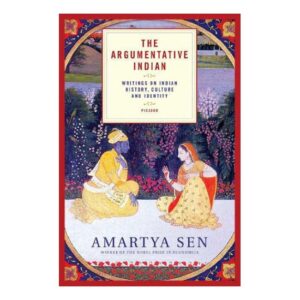
The Argumentative Indian: Writings on Indian History, Culture and Identity
“The Argumentative Indian” by Amartya Sen explores India’s rich tradition of public debate and intellectual pluralism. Sen highlights the historical roots of this argumentative culture, emphasizing how figures like Ashoka and Akbar, along with various scholars, have fostered a society that values dialogue and dissent. This tradition, Sen argues, is crucial to understanding India’s diverse and democratic nature.
Sen connects this historical tradition to contemporary issues, discussing democracy, secularism, and human rights in modern India. He shows how the argumentative heritage can inform and address today’s challenges, such as economic development, social inequality, and religious conflicts. Embracing this culture of debate is essential for India’s progress and problem-solving.
Lastly, Sen critiques the Western-centric view of India and advocates for a more nuanced understanding of its culture and history. By highlighting India’s contributions to global intellectual traditions, he challenges stereotypes and misconceptions. “The Argumentative Indian” calls for a greater appreciation of India’s intellectual heritage and its role in promoting dialogue and reasoned debate to build a more inclusive and just society.
₨ 800.00 -
Apprenticed to a Himalayan Master: A Yogi’s Autobiography
The author Sri ‘M’ is an extraordinary individual. His uniqueness lies not only in the fact that at the young age of 19 and a half, he travelled to snow clad Himalayas from Kerala, and there he met and lived for several years with a ‘real-time’ yogi, Babaji, but also that he should undertake such an unusual and adventurous exploration, given his non-Hindu birth and antecedents.
The metamorphosis of Mumtaz Ali Khan into Sri ‘M’, a yogi with profound knowledge of the Upanishads and deep personal insights, born of first hand experiences with higher levels of consciousness is indeed a fascinating story.
The bonus for those interested in the secrets of yoga, meditation and sankhyan metaphysics is that Sri ‘M’ is still living and easily reachable. He leads a normal life, married with two children, wears no special robes and conducts himself without pomp or paraphernalia.Someone who met him recently said, “I expected a flashy godman and instead I saw a jean clad gentleman with a smile of his face, ready to discuss my problems. In five minutes flat, I said to myself, this is no ordinary man. The peace and tranquility that enters your system is tangible
₨ 800.00 -
21 Lessons for the 21st Century
Yuval Noah Harari’s 21 Lessons for the 21st Century is a probing and visionary investigation into today’s most urgent issues as we move into the uncharted territory of the future. As technology advances faster than our understanding of it, hacking becomes a tactic of war, and the world feels more polarized than ever, Harari addresses the challenge of navigating life in the face of constant and disorienting change and raises the important questions we need to ask ourselves in order to survive.
Yuval Noah Harari’s “21 Lessons for the 21st Century” delves into pressing issues of our time, examining the impact of technology, the rise of fake news, the relevance of nations and religions, and the challenges of navigating an uncertain future. Harari’s exploration spans twenty-one chapters, addressing political, technological, social, and existential concerns with depth and insight.
In this visionary work, Harari grapples with the rapid pace of technological advancement and its implications for personal freedom and privacy. He discusses the evolving nature of work in the face of automation and offers insights into combating terrorism and understanding the crisis facing liberal democracy.
Drawing on his expertise in history and philosophy, Harari provides guidance on how to navigate a world inundated with information and uncertainty. He prompts readers to reflect on their values, find meaning, and engage meaningfully amidst the chaos of modern life.
With clarity and accessibility, “21 Lessons for the 21st Century” offers essential reading for those seeking to understand and confront the complex challenges of our time.
₨ 1,120.0021 Lessons for the 21st Century
₨ 1,120.00 -
The Way of the Superior Man: A Spiritual Guide to Mastering the Challenges of Women, Work, and Sexual Desire
Though much has changed in society since the first publication of The Way of the Superior Man, men of all ages still “tussle with the challenges of women, work, and sexual desire.” Including an all-new preface by author David Deida, this 20th-anniversary edition of the classic guide for men offers the next generation the opportunity to cultivate trust in the moment and put forth the best versions of themselves in an ever-changing world.
In The Way of the Superior Man, Deida explores the most important issues in men’s lives – from career and family to women and intimacy to love and spirituality – to offer a practical guidebook for living a masculine life of integrity, authencity, and freedom.
₨ 1,120.00