


-
The Honjin Murders (Detective Kosuke Kindaichi #1)
One of Japan’s greatest classic murder mysteries, introducing their best loved detective, translated into English for the first time.
In the winter of 1937, the village of Okamura is abuzz with excitement over the forthcoming wedding of a son of the grand Ichiyanagi family. But amid the gossip over the approaching festivities, there is also a worrying rumour – it seems a sinister masked man has been asking questions around the village.
Then, on the night of the wedding, the Ichiyanagi household are woken by a terrible scream, followed by the sound of eerie music. Death has come to Okamura, leaving no trace but a bloody samurai sword, thrust into the pristine snow outside the house. Soon, amateur detective Kosuke Kindaichi is on the scene to investigate what will become a legendary murder case, but can this scruffy sleuth solve a seemingly impossible crime?
₨ 590.00 -
The Inugami Curse (Detective Kosuke Kindaichi #6)
A fiendish classic murder mystery, from one of Japan’s greatest crime writers.
In 1940s Japan, the wealthy head of the Inugami Clan dies, and his family eagerly await the reading of the will. But no sooner are its strange details revealed than a series of bizarre, gruesome murders begins. Detective Kindaichi must unravel the clan’s terrible secrets of forbidden liaisons, monstrous cruelty, and hidden identities to find the murderer, and lift the curse wreaking its bloody revenge on the Inugamis.
The Inugami Curse is a fiendish, intricately plotted classic mystery from a giant of Japanese crime writing, starring the legendary detective Kosuke Kindaichi.
₨ 590.00 -
The Devil’s Flute Murders (Detective Kosuke Kindaichi #8)
An ingenious and highly atmospheric classic whodunit from Japan’s master of crime.
Amid the rubble of post-war Tokyo, inside the grand Tsubaki house, a once-noble family is in mourning.
The old viscount Tsubaki, a brooding, troubled composer, has been found dead.
When the family gather for a divination to conjure the spirit of their departed patriarch, death visits the house once more, and the brilliant Kosuke Kindaichi is called in to investigate.
But before he can get to the truth Kindaichi must uncover the Tsubakis’ most disturbing secrets, while the gruesome murders continue…
₨ 590.00 -
Murakami : What i talk about when i talk about Running
In 1982, having sold his jazz bar to devote himself to writing, Murakami began running to keep fit. A year later, he’d completed a solo course from Athens to Marathon, and now, after dozens of such races, not to mention triathlons and a dozen critically acclaimed books, he reflects upon the influence the sport has had on his life and—even more important—on his writing.
Equal parts training log, travelogue, and reminiscence, this revealing memoir covers his four-month preparation for the 2005 New York City Marathon and takes us to places ranging from Tokyo’s Jingu Gaien gardens, where he once shared the course with an Olympian, to the Charles River in Boston among young women who outpace him. Through this marvelous lens of sport emerges a panorama of memories and insights: the eureka moment when he decided to become a writer, his greatest triumphs and disappointments, his passion for vintage LPs, and the experience, after fifty, of seeing his race times improve and then fall back.
By turns funny and sobering, playful and philosophical, What I Talk About When I Talk About Running is rich and revelatory, both for fans of this masterful yet guardedly private writer and for the exploding population of athletes who find similar satisfaction in running.
₨ 800.00 -

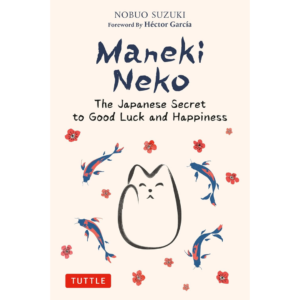
Maneki Neko: The Japanese Secret to Good Luck and Happiness
What does “good luck” look like and how do you achieve it?
Lucky symbols, lucky numbers, lucky charms and luck-creating rituals–how is it that a disciplined and hard-working country like Japan is so invested in the idea of luck? And what, exactly, does “good luck” mean?
This insightful book–by a leading expert on the subject–explores the ways in which “good luck” symbols and rituals in Japan are used in tandem with diligence and a positive attitude to help people overcome life’s many twists, turns and bad patches.
It explores how customs and beliefs play a vital role in creating positive expectations and outcomes–and includes practical exercises for bringing good fortune and happiness into your own life.
Author Nobuo Suzuki acquaints us with beloved Japanese icons of luck, prosperity, and goal-setting and explains what they truly represent–including Maneki Neko (the “Lucky Cat”), Daruma (the “Lucky Buddha”) and the Seven Lucky Gods of Good Fortune. We even meet some quirky and much beloved modern Japanese symbols of luck like the “Golden Poop” (yes, you read that right!). And we learn how these symbols all foster a sense of community which contributes to the happiness and well-being of all individuals in Japan.
With this book, luck becomes a matter of self-understanding and connection to others rather than something that exists outside of ourselves and other people. It is an integral part of life and learning to shape out a destiny for ourselves that we can view with pride and contentment.
₨ 880.00 -
Before the Coffee Gets Cold
What would you change if you could go back in time?
In a small back alley in Tokyo, there is a café which has been serving carefully brewed coffee for more than one hundred years. But this coffee shop offers its customers a unique experience: the chance to travel back in time.
In Before the Coffee Gets Cold, we meet four visitors, each of whom is hoping to make use of the café’s time-travelling offer, in order to: confront the man who left them, receive a letter from their husband whose memory has been taken by early onset Alzheimer’s, to see their sister one last time, and to meet the daughter they never got the chance to know.
But the journey into the past does not come without risks: customers must sit in a particular seat, they cannot leave the café, and finally, they must return to the present before the coffee gets cold . . .
Toshikazu Kawaguchi’s beautiful, moving story explores the age-old question: what would you change if you could travel back in time? More importantly, who would you want to meet, maybe for one last time?
₨ 880.00Before the Coffee Gets Cold
₨ 880.00 -
Killing Commendatore
A tour de force of love and loneliness, war and art, Killing Commendatore is a stunning work of imagination from one of our greatest writers.
When a thirty-something portrait painter is abandoned by his wife, he secludes himself in the mountain home of a world famous artist. One day, the young painter hears a noise from the attic, and upon investigation, he discovers a previously unseen painting. By unearthing this hidden work of art, he unintentionally opens a circle of mysterious circumstances; and to close it, he must undertake a perilous journey into a netherworld that only Haruki Murakami could conjure.
₨ 960.00Killing Commendatore
₨ 960.00 -
Hard-Boiled Wonderland and the End of the World
‘A narrative particle accelerator that zooms between Wild Turkey Whiskey and Bob Dylan, unicorn skulls and voracious librarians, John Coltrane and Lord Jim. Science fiction, detective story and post-modern manifesto all rolled into one rip-roaring novel, Hard-Boiled Wonderland and the End of the World is the tour de force that expanded Haruki Murakami’s international following. Tracking one man’s descent into the Kafkaesque underworld of contemporary Tokyo, Murakami unites East and West, tragedy and farce, compassion and detachment, slang and philosophy.’
₨ 960.00 -
Wabi Sabi: Japanese Wisdom for a Perfectly Imperfect Life
‘A truly transformative read’ Sunday Times STYLE
‘More than ever, we need books like this’ Jessica Seaton, Co-Founder of Toast and author of Gather, Cook, Feast
A whole new way of looking at the world – and your life – inspired by centuries-old Japanese wisdom.
Wabi sabi ( “wah-bi sah-bi” ) is a captivating concept from Japanese aesthetics, which helps us to see beauty in imperfection, appreciate simplicity and accept the transient nature of all things. With roots in zen and the way of tea, the timeless wisdom of wabi sabi is more relevant than ever for modern life, as we search for new ways to approach life’s challenges and seek meaning beyond materialism.
Wabi sabi is a refreshing antidote to our fast-paced, consumption-driven world, which will encourage you to slow down, reconnect with nature, and be gentler on yourself. It will help you simplify everything, and concentrate on what really matters.
From honouring the rhythm of the seasons to creating a welcoming home, from reframing failure to ageing with grace, wabi sabi will teach you to find more joy and inspiration throughout your perfectly imperfect life.
This book is the definitive guide to applying the principles of wabi sabi to transform every area of your life, and finding happiness right where you are.
₨ 1,120.00 -
What You Are Looking for Is in the Library
For fans of The Midnight Library and Before the Coffee Gets Cold, this charming Japanese novel shows how the perfect book recommendation can change a reader’s life.
What are you looking for?
This is the famous question routinely asked by Tokyo’s most enigmatic librarian, Sayuri Komachi. Like most librarians, Komachi has read every book lining her shelves—but she also has the unique ability to read the souls of her library guests. For anyone who walks through her door, Komachi can sense exactly what they’re looking for in life and provide just the book recommendation they never knew they needed to help them find it.
Each visitor comes to her library from a different juncture in their careers and dreams, from the restless sales attendant who feels stuck at her job to the struggling working mother who longs to be a magazine editor. The conversation that they have with Sayuri Komachi—and the surprise book she lends each of them—will have life-altering consequences.
With heartwarming charm and wisdom, What You Are Looking For Is in the Library is a paean to the magic of libraries, friendship and community, perfect for anyone who has ever found themselves at an impasse in their life and in need of a little inspiration.
₨ 1,120.00What You Are Looking for Is in the Library
₨ 1,120.00 -
First Person Singular
A mindbending new collection of short stories from the unique, internationally acclaimed author of Norwegian Wood and The Wind-up Bird Chronicle. THE SUNDAY TIMES BESTSELLER
The eight masterly stories in this new collection are all told in the first person by a classic Murakami narrator. From nostalgic memories of youth, meditations on music and an ardent love of baseball to dreamlike scenarios, an encounter with a talking monkey and invented jazz albums, together these stories challenge the boundaries between our minds and the exterior world. Occasionally, a narrator who may or may not be Murakami himself is present. Is it memoir or fiction? The reader decides.
Philosophical and mysterious, the stories in First Person Singular all touch beautifully on love and solitude, childhood and memory. . . all with a signature Murakami twist. A GUARDIAN AND SUNDAY TIMES ‘BOOKS OF 2021’ PICK
₨ 1,280.00First Person Singular
₨ 1,280.00 -
Kafka on the Shore (Hardcover)
A beautifully packaged hardback edition of Haruki Murakami’s mesmerizingly surreal classic, now with a new introduction by the author
Kafka Tamura runs away from home at fifteen, under the shadow of his father’s dark prophesy.
The aging Nakata, tracker of lost cats, who never recovered from a bizarre childhood affliction, finds his pleasantly simplified life suddenly turned upside down.
As their parallel odysseys unravel, cats converse with people; fish tumble from the sky; a ghost-like pimp deploys a Hegel-spouting girl of the night; a forest harbours soldiers apparently un-aged since World War II. There is a savage killing, but the identity of both victim and killer is a riddle – one of many which combine to create an elegant and dreamlike masterpiece.
‘Wonderful… Magical and outlandish’ Daily Mail
‘Hypnotic, spellbinding’ The Times‘Cool, fluent and addictive’ Daily Telegraph
₨ 2,080.00Kafka on the Shore (Hardcover)
₨ 2,080.00